

Somewhere above Lake Como, at nearly a thousand meters above sea level, water moves through ancient Dolomitic rock. By the time it surfaces, it carries something the rock gave it: a mineral signature that no amount of processing or filtering can replicate, because it wasn't made in a facility. It was made by time and geology.
This is where the idea of natural mineral water begins. Not in a bottling plant and not on a label, but instead, underground, in the quiet passage of water through the earth.
What Mineral Water Actually Is
Natural mineral water is a specific classification, not a marketing term. The Food and Drug Administration defines it as water containing no less than 250 parts per million (PPM) of total dissolved solids, which are the minerals and trace elements that the water absorbed from its underground source. It must be bottled directly at that source, and its mineral content must be naturally occurring. Nothing can be added afterward.
Most bottled water sold today is filtered, treated, or purified tap water, sometimes with minerals added back in to improve taste. Natural mineral water works the other way around. Its mineral composition is a consequence of where it came from and how long it was there. Every bottle carries the chemical characteristics of a particular place.
The mineral content of a natural mineral water must also appear on the label. This is legally required. You're entitled to know exactly what you're drinking: the calcium, the magnesium, the sodium, and the trace elements. That transparency is part of what strict regulations protect.
Mineral Water vs. Spring Water vs. Drinking Water
Natural Mineral Water
This is the most tightly regulated category. The water must come from a geologically protected underground source, be bottled directly at that origin, and carry a minimum of 250 parts per million of naturally occurring dissolved solids. Manufacturers are required by law to list the full mineral composition on the label, so what you read is what's in the bottle, nothing added, nothing removed.
Spring Water
Spring water also comes from underground, and it must flow naturally to the surface or be collected at the point where it would emerge on its own. The sourcing standards have some overlap with mineral water, but the key difference is that spring water has no minimum mineral requirement, and the label doesn't have to tell you what minerals are actually present. You might be getting something genuinely mineral-rich, or something quite unremarkable. The packaging won't necessarily tell you which.
Tap Water
Municipal tap water has no sourcing requirements and no obligation to maintain a consistent mineral profile. What's in it depends on where you live, the local water source, and how it's been treated. Some municipalities add fluoride or adjust hardness; others remove minerals during filtration. It's not inherently bad water, but it's water you can’t be 100% sure of its contents.
Distilled Water
Distilled water has been processed to strip out virtually everything dissolved in it, minerals included. What remains is chemically pure H₂O with no dissolved solids. Some people seek it out for that reason, but it's about as far from natural mineral water as you can get.
Note: Natural mineral water is the only category where you know exactly what you're getting, where it came from, and that it hasn't changed between the source and your glass.
Still and Sparkling: Same Source, Different Character
Mineral water is either still or sparkling. Sparkling water has carbon dioxide, which is the only thing that can be added to natural mineral water after bottling. Some sparkling mineral waters are naturally carbonated, meaning the CO₂ was present at the source and preserved through bottling. Most have it introduced during production.
What doesn't change between still and sparkling is the mineral composition. The water drawn from the same source carries the same calcium, magnesium, and bicarbonate regardless of carbonation. Still water expresses the source most quietly: smooth and mineral-forward, with nothing to compete with the mineral character itself. Sparkling is sharper, more present on the palate, well-suited to meals and long evenings.
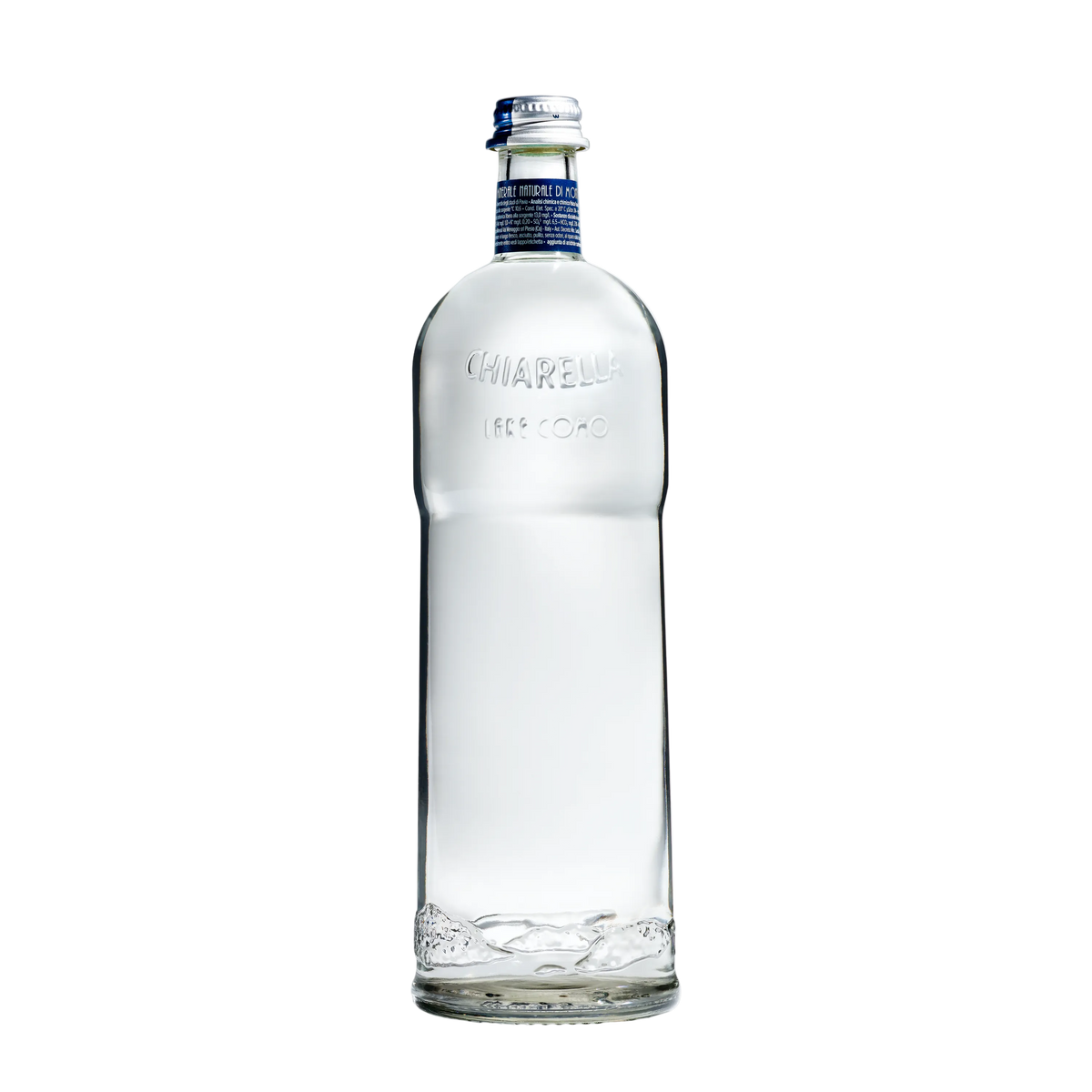
Chiarella offers both still and sparkling water from the same spring and the same Dolomitic rock.
Why Mineral Water Tastes the Way It Does
Two mineral waters can come from the same country, the same mountain range, and taste completely different from each other. This is where geology becomes personal because taste is a direct readout of what the water passed through on its way to the surface. Each mineral in the composition contributes something distinct:
- Calcium gives water a certain fullness, a roundness that sits gently on the palate.
- Magnesium adds a slight bitterness, almost crisp, which is why high-magnesium waters tend to feel cleaner at the finish.
- Bicarbonate softens the overall profile, accounting for the smooth, almost silky quality found in waters from alkaline geological sources.
- Sodium, in higher concentrations, makes water taste noticeably heavier and saltier.
- Sulfates push toward a drier, more mineral character.
High total dissolved solids generally mean a more pronounced, complex taste. Lower-total dissolved solids mineral waters are more neutral, closer to what most people know from filtered tap water, but with more depth underneath. The moderate range reads as clean and light, with just enough mineral presence to remind you that you're drinking something with a genuine origin.
This is also why serving temperature matters more than people think. Mineral water served too cold mutes the character the source spent centuries developing. Slightly cooler than room temperature, or lightly chilled, is where the mineral profile comes through most clearly.
Benefits of Mineral Water
Is mineral water good for you? The answer lives in the label. The minerals it carries (calcium, magnesium, bicarbonate) are the same ones the body relies on every day, and in mineral water, they arrive in a form the body can readily absorb.
Bone Health
Research has found that calcium from mineral water is bioavailable and absorbed as effectively as calcium from dairy products (Pop et al., 2023). Regular intake of calcium-rich mineral water may contribute to bone density over time.
Heart Health
Magnesium, which many people don't get enough of, supports healthy blood circulation and helps regulate heart rhythms. A meta-analysis published in Nutrients found that higher magnesium levels in drinking water were significantly associated with a reduced risk of coronary heart disease mortality (Jiang et al., 2016). Bicarbonate-rich mineral water has also been found to have a favorable effect on cholesterol, reducing LDL levels while supporting HDL, the kind associated with cardiovascular protection (Toxqui et al., 2012).
Digestion
Sparkling mineral water, in particular, has documented effects on digestive health. A clinical study found that carbonated water reduced constipation scores and improved gallbladder emptying in patients with functional dyspepsia, while tap water produced no significant change (Cuomo et al., 2002). Magnesium-rich water may also help by drawing water into the intestines and relaxing intestinal muscles. More broadly, natural mineral waters have been found to stimulate gastric function in ways that plain drinking water does not.
Blood Pressure
Mineral composition matters here, too. Research suggests that regular consumption of mineral water may help support healthy blood pressure, particularly among people with low magnesium and calcium intake (Jiang, L. et al., 2016). High sodium content works against this, which is why the sodium number on the label is worth a look, not just the mineral highlights.
How to Choose a Mineral Water Worth Drinking
Natural mineral water is required by law to list its full mineral composition, and understanding the benefits of mineral water starts with reading the label. Here are a few things to consider when choosing mineral water.
Mineral Content
Calcium and magnesium are the minerals that do the most work for the body, so those numbers are worth checking first. Sodium content matters too. For daily drinking, especially on a low-sodium diet, lower is better. Some mineral waters carry well over 200 mg/l of sodium; others, like those sourced from the Italian Alps, carry less than 1 mg/l.
For example, Chiarella's mountain spring mineral water contains one of the lowest sodium levels in Europe, making it particularly well-suited for everyday hydration.
Total Dissolved Solids (TDS)
TDS gives you an overall read on mineral concentration. Anything above 250 ppm qualifies as natural mineral water. The sweet spot for daily drinking tends to fall in the moderate range: concentrated enough to deliver minerals meaningfully, light enough to drink without a second thought.
The Source
Where the water comes from shapes everything about it. A geologically protected underground source, bottled at origin, with a documented mineral profile that holds constant across batches, is the mark of water that takes its classification seriously. Original purity means nothing has been altered between the earth and the bottle.
The Bottle
Plastic, specifically polyethylene terephthalate, is now well-documented as a source of microplastic contamination in bottled water. Studies have found microplastic particles in water stored in Polyethylene Terephthalate (PET) bottles, with concentrations increasing over time and with heat exposure (Epic Water Filters, 2024). For water defined partly by its purity, and by what it doesn't contain, packaging in plastic introduces a contradiction that glass simply doesn't. Glass is inert. It doesn't interact with the water, leach anything into it, or degrade in a way that affects what's inside. The mineral profile you read on the label is the mineral profile in the bottle, nothing added, nothing altered.
Chiarella water contains 41.6 mg/l of calcium and 23 mg/l of magnesium, along with 0.9 mg/l of sodium, among the lowest levels in Europe. Sourced at nearly a thousand meters above sea level, our glass-bottled water comes from the Plesio facility above Lake Como.
Beyond the Glass
Mineral water doesn't have to stop at hydration. In the kitchen, its mineral composition subtly changes what it touches: stock simmered in mineral water develops differently, bread made with it has a different crumb, and poached fish absorbs the character of the water it cooks in. Bars use quality mineral water for ice, knowing that what the ice is made of eventually becomes part of the drink.
It’s easy to store and travel with mineral water as it doesn't need refrigeration. And there's something worth holding onto in the idea that drinking water from a specific source is a kind of connection to place: to the Alps, to a particular spring, or even to centuries of geology working quietly underground.
That's what natural mineral water offers that no other category can. Not just hydration, but a story the earth started, and the bottle finished. Explore Chiarella's still and sparkling mineral water to find the one that suits your table.
References
- Cuomo, R., Grasso, R., Sarnelli, G., Capuano, G., Nicolai, E., Nardone, G., Pomponi, D., Budillon, G., & Ierardi, E. (2002). Effects of carbonated water on functional dyspepsia and constipation. European Journal of Gastroenterology & Hepatology, 14(9), 991–999. https://doi.org/10.1097/00042737-200209000-00004
- Jiang, L., He, P., Chen, J., Liu, Y., Liu, D., Qin, G., & Tan, N. (2016). Magnesium levels in drinking water and coronary heart disease mortality risk: A meta-analysis. Nutrients, 8(1), 5. https://doi.org/10.3390/nu8010005
- Manuela Simona Pop et al. Exploring the Potential Benefits of Natural Calcium-Rich Mineral Waters for Health and Wellness: A Systematic Review.
- Plastic Water Bottles Microplastics. How to avoid microplastics in water. Epic Water Filters, 2024.
- Toxqui, L., Pérez-Granados, A. M., Blanco-Rojo, R., & Vaquero, M. P. (2012). A sodium-bicarbonated mineral water reduces gallbladder emptying and postprandial lipaemia: A randomised four-way crossover study. European Journal of Nutrition, 51(5), 607–614.


